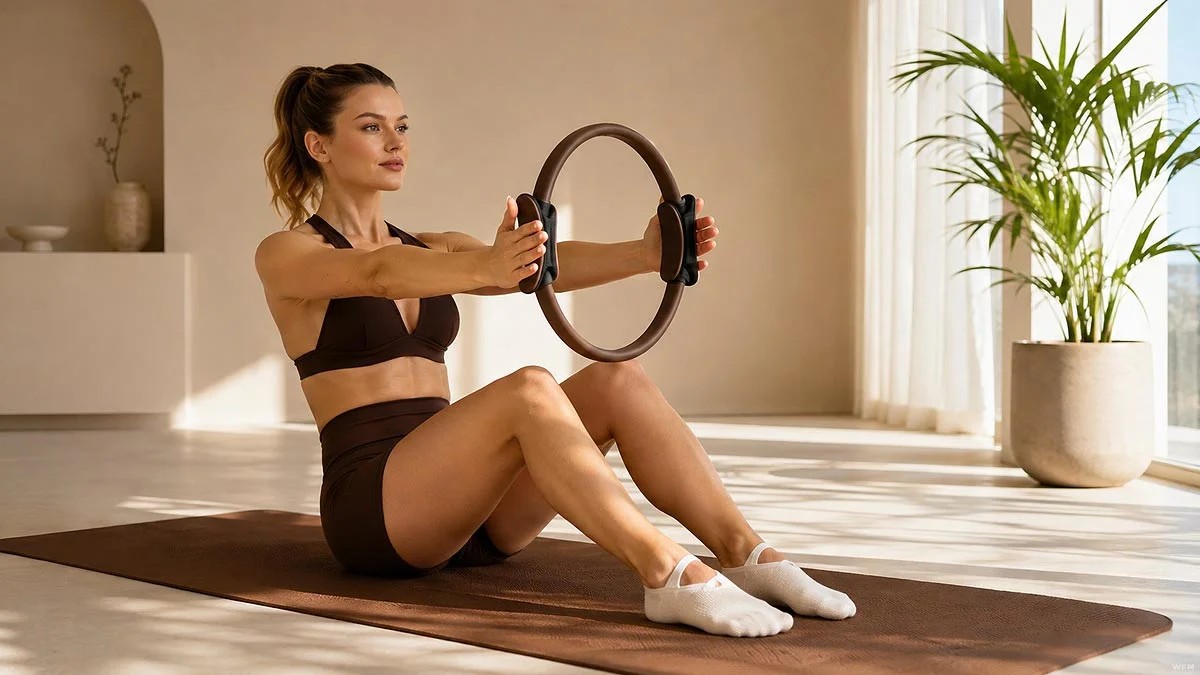
Ever squeezed a pillow between your knees? Your inner thighs probably fired up immediately. A Pilates ring does that, but with actual structure.
It’s a flexible circle. Small enough to toss in a bag. Big enough to add real resistance to bodyweight moves.
You’re going to learn how this “magic circle” works. Plus, three specific exercises for your legs and arms. And how to fit it into a chaotic week without needing a studio.
How Resistance Actually Works
You press the sides together. The ring pushes back. That’s it.
Simple physics. But it changes how your muscles engage. You aren’t just moving; you’re holding steady against pressure. That’s isometric work.
The ring’s resistance hints when you’re pressing unevenly. If one side gives more, stop. Correct your form.
It’s not about a death grip. A moderate squeeze activates the muscles better than a frantic clench. You’re targeting the inner thighs, arms, glutes, and core.
Don’t expect it to replace heavy weights for bodybuilding. But for toning and control? It’s highly effective.
Ring vs. Bands vs. Weights
Why choose a magic circle over other tools? It’s about the feel.
- Resistance bands stretch. They’re great for full-body tension. But they take up space in a drawer.
- Light dumbbells add weight. You need room to swing them safely. Storage is an issue.
- The Pilates ring squeezes. It’s compact. It fits under a couch. It’s low-impact.
Pick the tool that fits your floor plan. Many people keep both a band and a ring. Rotate them. Keep things fresh.
Three Moves for Inner Thighs and Arms
Let’s get practical. Here are three beginner-friendly exercises.
Note: You can’t spot-reduce fat. Your body decides where it loses weight first. These moves build the muscle underneath. That’s the real win.
1. The Inner-Thigh Ring Squeeze
Goal: Activate the adductors (inner thighs) and lower core.
Start: Lie on your back. Knees bent. Feet flat on the floor. Place the ring between your knees, just above the calves.
Move: Gently press your knees inward against the ring. Hold for two seconds. Ease off slowly. Don’t jerk it.
Reps: 10–12. Slow and controlled.
Easier version: Sit in a chair. Keep your back straight. Squeeze the ring between your knees. It works just as well if you can’t lie down.
2. Seated or Standing Chest Press
Goal: Engage the chest, triceps, and front shoulders.
Start: Sit or stand tall. Hold the ring horizontally at chest height. Palms facing the ring.
Move: Press your palms together. The ring compresses. Hold briefly. Release.
Reps: 10 controlled presses.
Easier version: Move the ring to your lap. It changes the angle, making it less demanding on the shoulders.
3. Bridge With Ring Squeeze
Goal: Glutes, hamstrings, core, and inner thighs.
Start: Same as the squeeze. Lie on your back, ring between knees.
Move: Lift your hips into a bridge position. Keep the ring squeezed throughout the lift. Lower slowly.
Reps: 8–10 lifts.
Easier version: Skip the hip lift. Just practice the squeeze while lying flat. Master the activation first.
Clean movement beats rushed reps. Every single time.
Why It Belongs in Your Home Gym
Storage. Portability. Simplicity.
The ring slides under a bed. It goes into a purse. It’s ready for a five-minute break between emails.
If you’re shopping for one, look for padded grips. They’re softer on the skin. You’ll be using this daily. Comfort matters.
Choose a flex level that feels steady, not brittle. If you want a starting point, look for a standard resistance ring. It’s not a magic bullet. It’s a helper.
Form Tips: Don’t Over-Clamp
More pressure isn’t always better. In fact, it often leads to poor form.
- Shoulders: Keep them down. Don’t shrug toward your ears during the chest press.
- Spine: Stay neutral. No arching the lower back.
- Breathing: Don’t hold your breath. Exhale on the exertion.
- Speed: Slow down. If you’re moving fast, you’re using momentum, not muscle.
Stop if it hurts. Discomfort is fine. Sharp pain is not.
Is a 15-Minute Session Enough?
Short sessions stack up.
A 15-minute workout isn’t a magic weight-loss hack. But consistency is. If you do it three times a week, you’re building a habit.
Your results depend on:
- Technique: Are you actually engaging the right muscles?
- Frequency: Are you showing up regularly?
- Daily Activity: How much do you move outside the workout?
- Rest/Nutrition: You can’t out-train a bad diet or sleep deprivation.
Think of the ring as a tool for consistency. Not a shortcut.
Common Questions
How often should I use it?
Two to four times a week is a sweet spot for most. Spread it out. Muscles need rest to adapt.
Do I need other gear?
No. A yoga mat helps, but it’s optional. A towel under your head for comfort is a nice touch. The ring stands alone.
Can beginners use it?
Yes. You control the squeeze intensity. Start light. Build strength slowly. It’s forgiving.
The Pilates ring is small. But it’s effective. Try one move today. See how your body feels. Then decide if you want to add more.
It’s summer. Get moving.