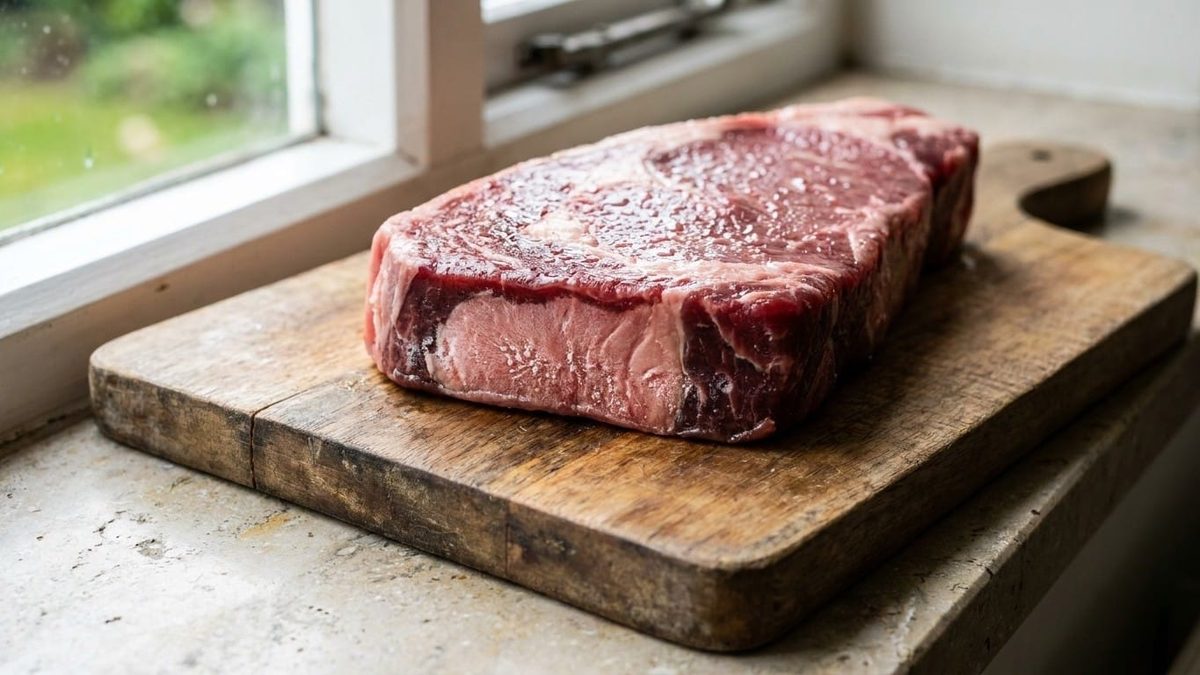
That steak sitting on the kitchen counter, slowly turning pink in the morning light. It feels normal. It feels safe. But for millions of households, this simple act is a ticking time bomb.
According to ANSES, 73% of French people thaw their meat at room temperature. They leave it on the countertop. In the open air. For hours. It is a reflex inherited from grandmothers, but it is also one of the most risky food errors you can make.
The hidden math behind bacterial growth
Freezing doesn’t kill bacteria. It puts them in a coma. They hibernate until the temperature rises. Once you go above 4 °C, they wake up. And they wake up hungry.
Between 10 °C and 40 °C, bacteria like Salmonella can double their population every 20 minutes. Do the math.
If you leave a piece of meat on the counter for just two hours, one single bacterium becomes 4,096. The risk of salmonellosis isn’t a myth. It is multiplied by 16 after that brief window.
Here is the trap most people fall into. The center of the meat stays frozen. But the surface? It hits the perfect temperature for microbes to breed. The outside enters the danger zone (4 °C to 60 °C) while the inside is still ice. You are cooking a surface that is already teeming with life.
ANSES says that cold chain errors at home cause nearly 30% of food poisoning cases in France. That is hundreds of thousands of avoidable cases. All because of one bad habit.
It is not just a stomach ache
We tend to downplay food poisoning. “I felt a bit off. It passed.” Sometimes it does.
But Santé publique France reports 198,000 cases of salmonellosis per year in France. That is equivalent to the entire population of Rennes getting sick every year from contaminated food.
For pregnant women, the stakes are incredibly high. Salmonella can cross into the bloodstream and then the placenta. It threatens the fetus and can cause premature birth. It is not a game.
Listeria is another quiet killer. Studies show it is insensitive to both positive and negative cold. Refrigeration does not kill it. Cases have risen steadily since 2021, reaching 619 notified cases in 2024. Authorities are worried. They should be.
Three safe ways to thaw meat quickly
You forgot to take the chicken out the night before. Panic sets in. Do not put it on the counter. Use these methods instead.
1. The fridge (The best way)
ANSES recommends thawing in the refrigerator at 3 °C or below. It takes time. Three to four hours for small cuts. 12 to 24 hours for large roasts. It requires anticipation. It is the only real effort asked of you.
2. Cold water (The fast way)
If you are in a rush, use cold water. Place the meat in a sealed bag in a bowl of cold water. Change the water every 30 minutes to keep the temperature low. This works for large pieces and is faster than the fridge. Remember: cold water. Not warm. The nuance changes everything.
3. Microwave (The desperate way)
Only use the defrost setting. Follow the time and rest intervals exactly. There is one non-negotiable rule: cook the meat immediately after. Do not let it sit.
A special rule for ground meat
Here is something most people ignore. Frozen or fresh ground beef (steak haché) should never be thawed beforehand. It goes straight from the freezer to the pan.
Why? Because grinding mixes the internal and external bacteria throughout the entire volume. You cannot cook the surface alone. You must cook it through to the center. The Pasteur Institute is explicit about this. Skip the thawing step. It increases bacterial multiplication risk.
Cook the meat. Trust the process. Ignore the counter.
The Hidden Danger of Refreezing: Why It’s Not Just About Thawing
You’ve already mastered the thaw. But there is a final blind spot that can turn your careful planning into a health hazard. It is the act of refreezing raw food.
Think about the math. If you leave meat out, bacteria double every 20 minutes. Leave it at room temperature for three hours? That is nine cycles of doubling. Then, take another three hours to get it back into the freezer. By the time the center hardens, you are not dealing with the same microbial load you started with. You are looking at a 1,024-fold increase. One thousand twenty-four times more bacteria.
When you refreeze raw meat, you are not killing those microbes. You are locking them in. You are essentially imprisoning an army that has grown significantly larger than the one you began with.
The Only Safe Path: Cook Before You Freeze
The rule remains absolute. Never leave raw meat at room temperature. And avoid refreezing raw cuts entirely.
There is only one safe sequence that does not multiply risk. You must cook the thawed item completely. Then, you freeze the cooked dish.
A beef bourguignon made from thawed beef and then frozen is infinitely safer than a raw hamburger steak that you simply thawed and refroze. The heat of cooking breaks the bacterial chain. Freezing the cooked meal stops any remaining spores or survivors from multiplying further.
Refreezing raw meat doesn’t reset the clock. It just preserves the damage.
Practical Steps for Your Kitchen
- Plan Your Thaw. Move meat from the freezer to the fridge the night before. This keeps it cold. It keeps the bacteria dormant.
- Cook It All. If you have thawed a large batch of chicken or beef, cook it all. Divide it into portions.
- Freeze the Meal. Package the cooked portions. Now they are safe for later.
This approach works for almost everything. Chicken. Pork. Ground beef. The key is the transition from raw to cooked before the second freeze.
It is a small shift in routine. But it prevents the scenario where you pull out a “safe” piece of meat, only to find it has become a breeding ground.
The goal is not perfection. It is safety without stress. If you follow this path, your meals stay delicious. And they stay safe.