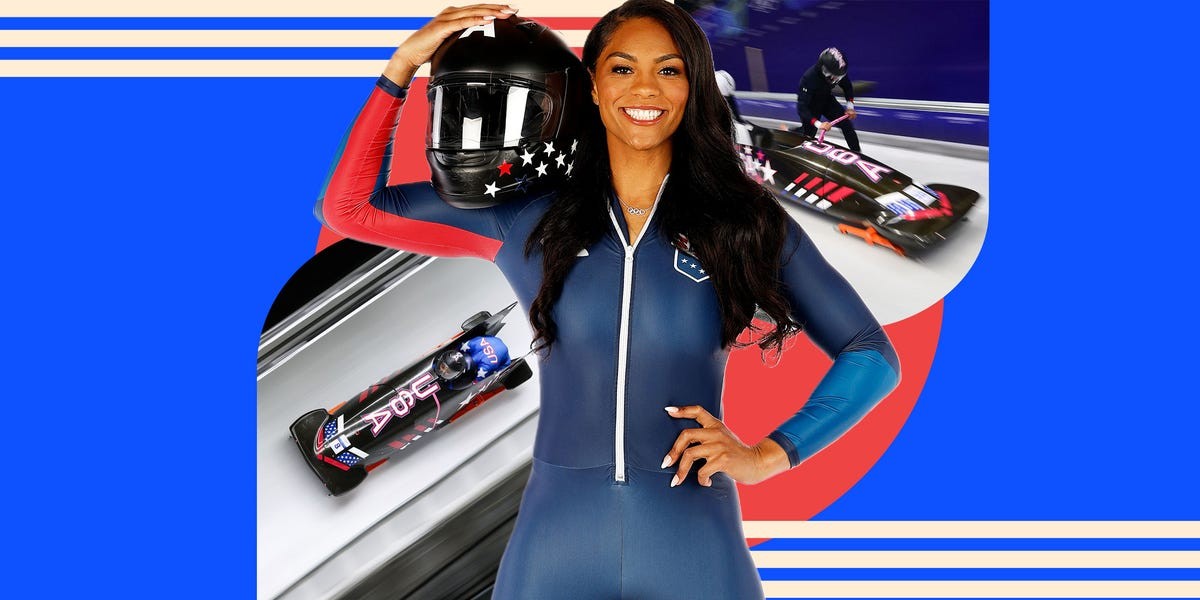
Kaysha Love, a 28-year-old athlete, has rapidly ascended in the high-stakes world of bobsled, making history as one of the few athletes to transition from brakewoman to pilot in under five years. Her journey underscores the increasing role of data and technology in modern winter sports, where fractions of a second can determine victory or defeat.
A Swift Transition
Love entered bobsled in 2020 after a successful track career at the University of Nevada, Las Vegas. Initially, she served as a brakewoman, responsible for the final push and brake activation. Her quick adaptation led to Olympic qualification in 2022, finishing seventh in the two-woman event alongside Kaillie Humphries. However, Love swiftly set her sights on piloting, a role demanding intense concentration, precise steering, and rapid decision-making. Within a year, she secured her first World Cup title in monobob and qualified for the 2026 Milan Cortina Winter Olympics—a feat many had deemed impossible.
The Power of Data: Honda’s Impact
A pivotal factor in Love’s rise is the innovative partnership between U.S. Bobsled/Skeleton (USABS) and Honda. The collaboration grants access to the Honda Automotive Laboratories of Ohio (HALO) wind tunnel, originally designed for vehicle aerodynamics. This facility now provides crucial racing data, allowing athletes to refine equipment and strategy with unprecedented precision.
Love credits the HALO facility as “a game changer,” enabling her to understand how minor adjustments—posture, entry angles—affect drag and speed. In competition, teams use real-time data to learn tracks faster, estimating optimal racing lines curve by curve. The partnership has fundamentally changed how teams approach major events, like the Milan Cortina Games.
Balancing Tech and Instinct
While data is crucial, Love emphasizes the importance of balancing it with instinct. She optimizes numbers in training but relies on muscle memory in competition, preventing data overload from hindering performance. The greatest challenge, she notes, is the courage to implement high-risk, high-reward adjustments, knowing that the fastest lines are often the most dangerous.
The stakes intensify in two-woman races, where mistakes carry greater consequences. “One small mistake could potentially mean that we crash,” Love admits, but the payoff for successful adjustments is exhilarating: “there’s nothing more exciting than when the data and the numbers come all together in real life on the track.”
Looking Ahead
Love finished seventh in monobob and fifth in two-woman at Milan Cortina, her first Olympics as a pilot. She acknowledges room for improvement and looks forward to a deepening partnership with Honda through 2030. The collaboration is mutually beneficial, as Honda gains insights into winter sports while Love refines her piloting skills.
“My career is not over. It’s just getting started,” Love states, shifting her focus from mere qualification to medal contention. Her performance at the Games reinforced the need for continued refinement, demonstrating that even rapid progress leaves room for further growth.
The intersection of athletic skill and cutting-edge technology is reshaping bobsled, and Kaysha Love embodies this evolution. Her journey from brakewoman to pilot illustrates how data-driven training and strategic partnerships can redefine what’s possible in elite winter sports.